The Perfect Steep™
Great tea is the leaf you start with, a bit of craft, and a little patient chemistry.
The difference between a memorable cup of tea and a forgettable one starts with the leaf — and then comes down to how well you treat it. Temperature, time, and amount are the three variables that control every steep, and they interact in ways nobody ever bothers to explain. Get all three right, and what ends up in the cup is something most people have never tasted.
There’s one thing technique can’t fix, though: the leaf itself. The standard worth holding out for is specific — certified organic, whole leaf, cleanly processed, and fully traceable from a single estate. Most tea doesn’t meet it. This tool was calibrated to that standard, informed by the recommendations of professional sommeliers working with a globally recognized single-estate tea from New Zealand — a country that takes its organic certification standards seriously, and where that designation means something. It was designed to show you what’s possible when the foundation is right.
Start with Recommended. Move the sliders. The coaching updates in real time and tells you exactly what each change is doing to the cup. Most people land somewhere surprising within a few minutes. For iced brewing, the chemistry shifts enough to deserve its own guide.
5 steps to an amazing cup of tea.
Select your tea type
Start with what you're brewing.
Select your brewing style
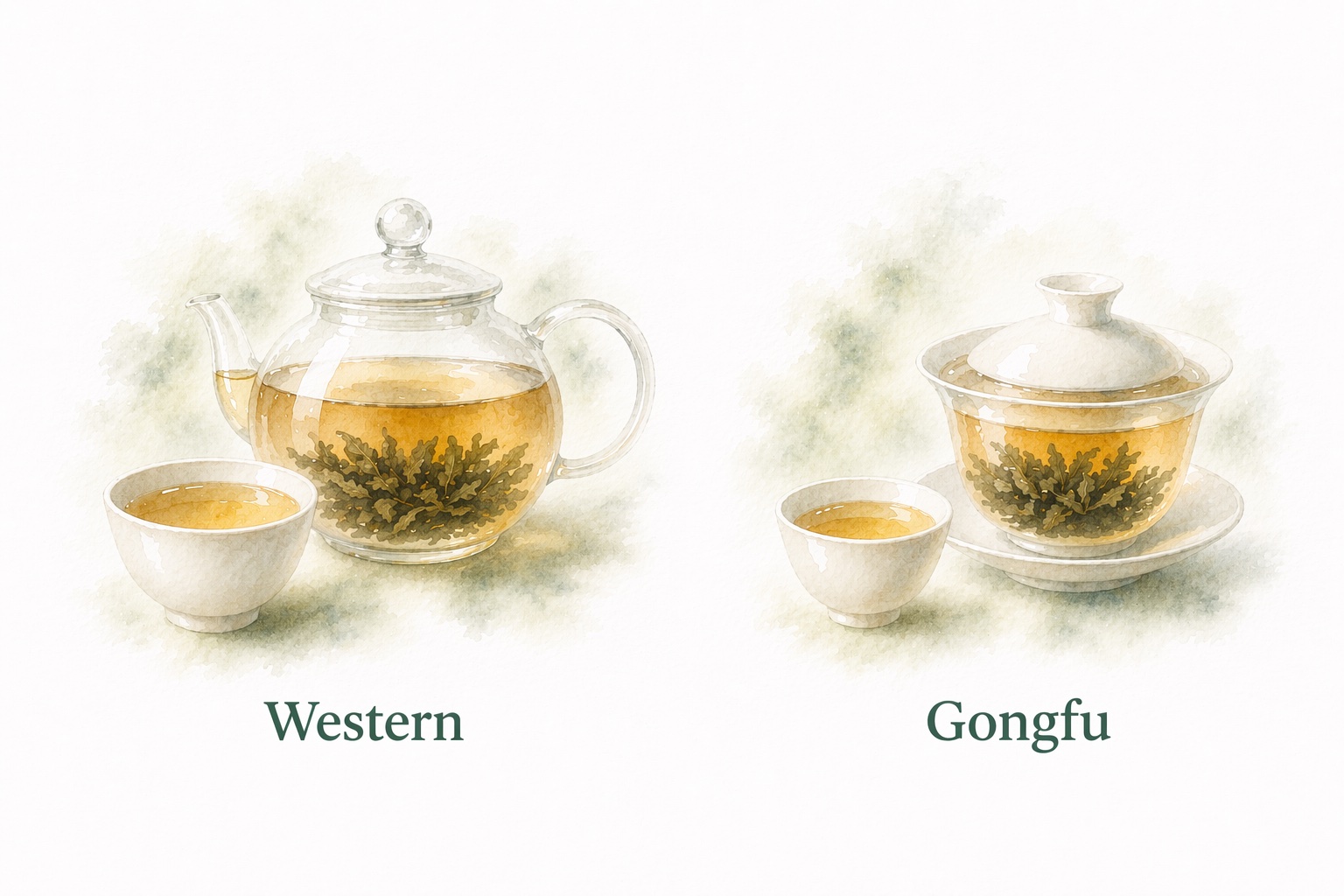
Two traditions, different results.
Select your vessel
Your vessel shapes the flavour.
Select your strength
Choose how bold you'd like your cup.
Your recommended formula
A great place to start.
Want to find your perfect custom steep?
Use the dials below. Your Sommelier is listening.
Single-cup extraction
Inside a single steep, flavour dimensions rise on different curves. The dashed line marks your chosen steep time.
Across infusions
Whole leaves release compounds in layers, so each infusion tastes different. Here's how this brew plays out across a session.
Great tea isn’t guessed.
It’s understood.
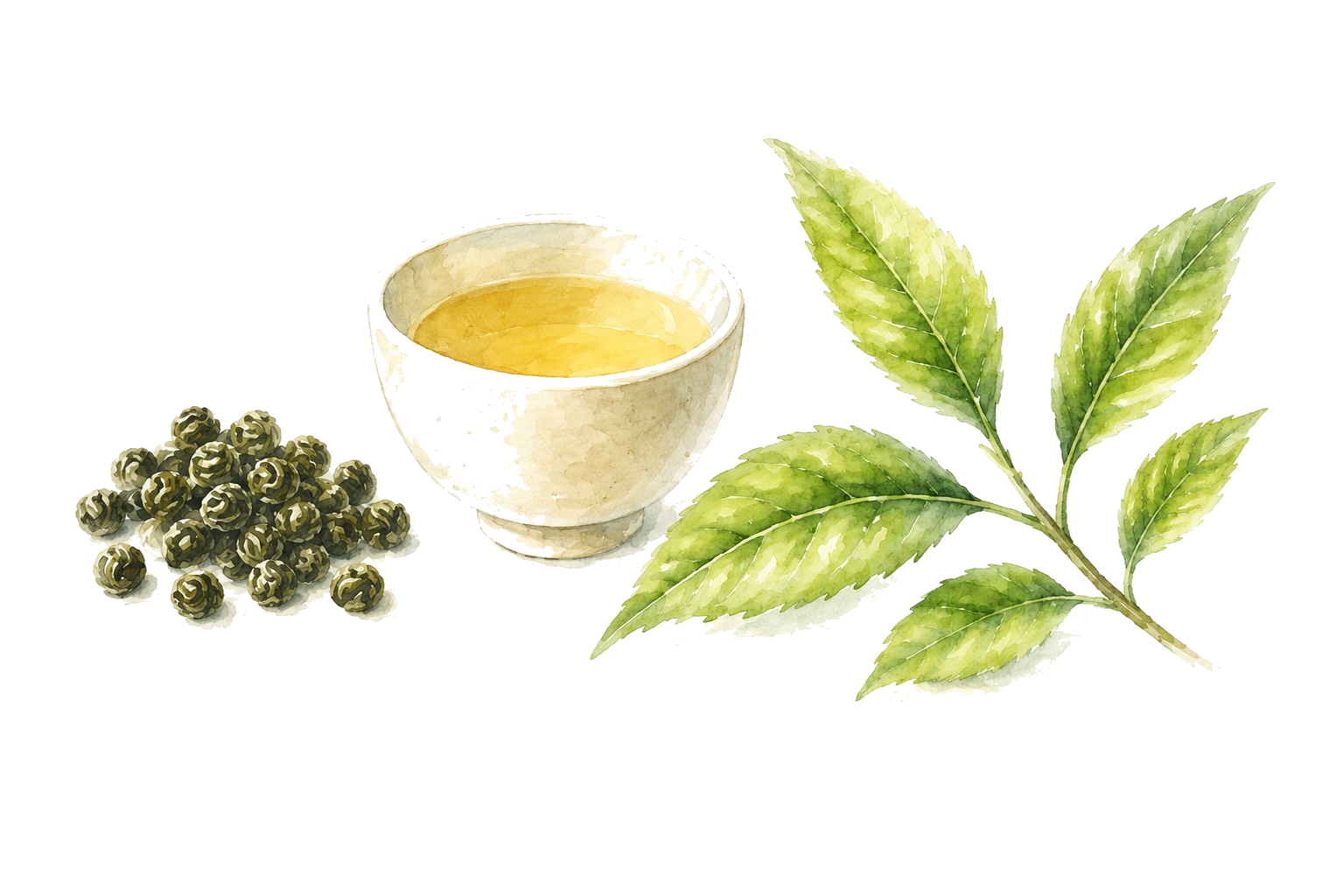
Brewing is extraction. The leaf decides what’s available to extract; the three variables — leaf amount, water temperature, and steep time — decide how much of it ends up in the cup.
Pesticide residue, dust from a careless supply chain, tea grown for yield rather than character — whatever is in the leaf, that’s what you taste.
By “tea,” we mean true tea: Camellia sinensis, the tea plant. Every variety you see in the simulator — green, oolong, black, breakfast — comes from the same species, processed differently. Herbal infusions like chamomile, peppermint, and rooibos are their own world and follow different chemistry; the framework here doesn’t apply to them.
The framework in this guide is calibrated for the standard of tea Taria imports: whole leaf, certified organic, cleanly processed, traceable. The same principles work for any tea — every cup has its own ceiling, set by the leaf you start with. Great leaf raises it.
Quality whole-leaf tea is hand-plucked as two leaves and a bud — the youngest, most chemically active part of the plant. Mass-market tea is machine-harvested and includes stems, older leaves, and broken pieces. The same Camellia sinensis bush can produce both, depending on what you pay for.
L-theanine is an amino acid found almost exclusively in Camellia sinensis, making up roughly 1 to 2 percent of a dry leaf. It gives tea its savory umami note and, research suggests, promotes alpha brain-wave activity within thirty to forty minutes — the calm, focused state tea drinkers have described for centuries. It’s also why tea’s caffeine feels smoother than coffee’s: theanine doesn’t cancel caffeine, it moderates it. Cooler water (140–160°F) extracts more theanine and less of the bitter catechins that come out above 176°F — which is why delicate green teas are brewed cool.
-
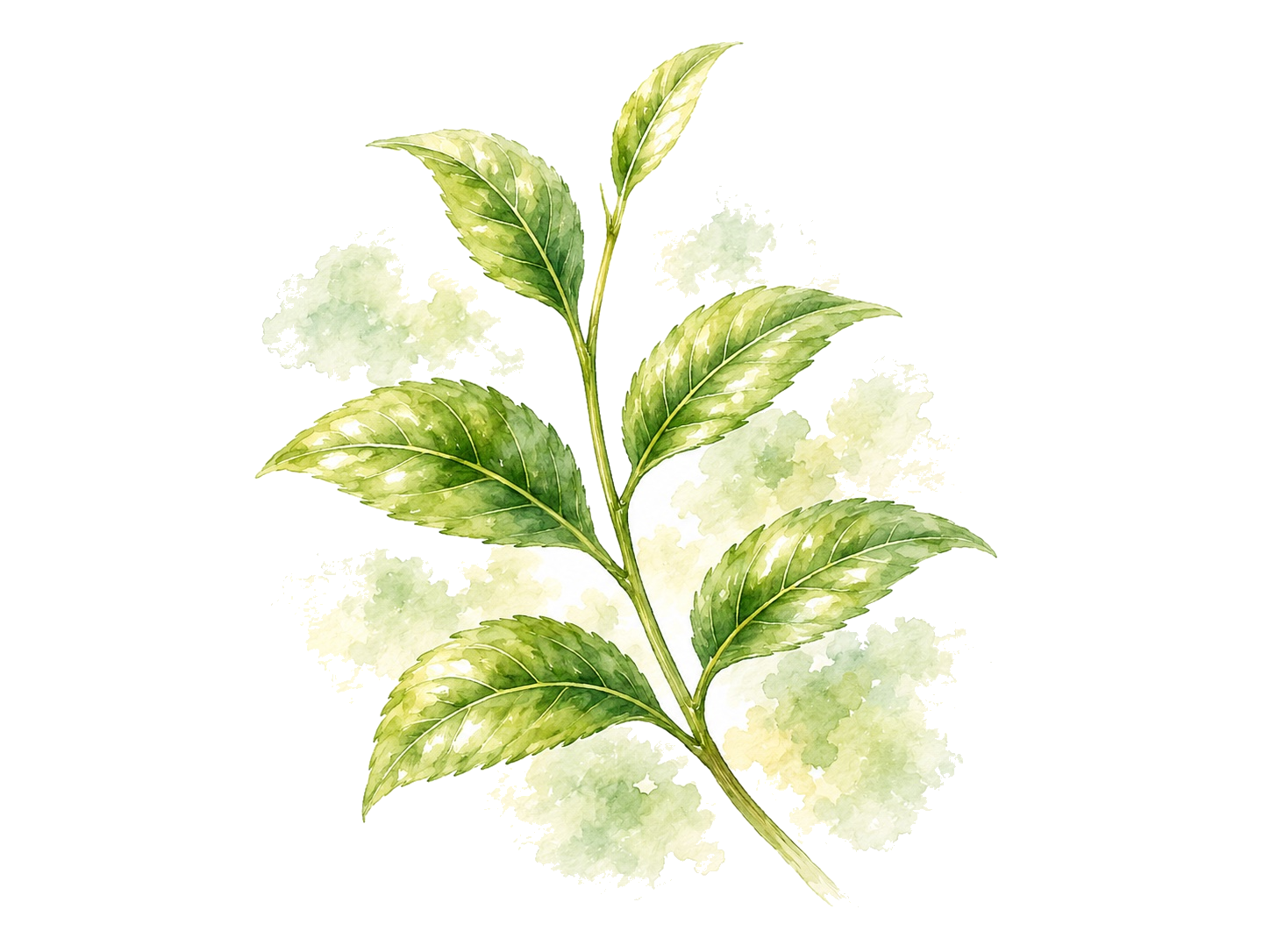
Camellia sinensisOne species. Different expressions.
-
Whole leafOpens with hot water and releases flavor in layers.
-
Clean & traceableBetter leaf leads to a better cup.
Brewing is extraction. The leaf decides what’s available; the water is the solvent that does the extracting. A great leaf in bad water gives you a disappointing cup.
Most people never notice because they’ve never tasted the same tea brewed with both.
Chlorine gets in the way
Municipal systems add chlorine (and chloramine) to keep pipes sanitary. You may not notice it in a glass of tap water, but it reacts with the aromatic compounds in tea during steeping, muting the top notes and leaving a slightly chemical edge behind.
- Boiling can reduce chlorine
- Boiling does not remove chloramine
- A basic carbon filter handles both
Mineral balance matters
Tea wants minerals — but too little or too much can throw it off.
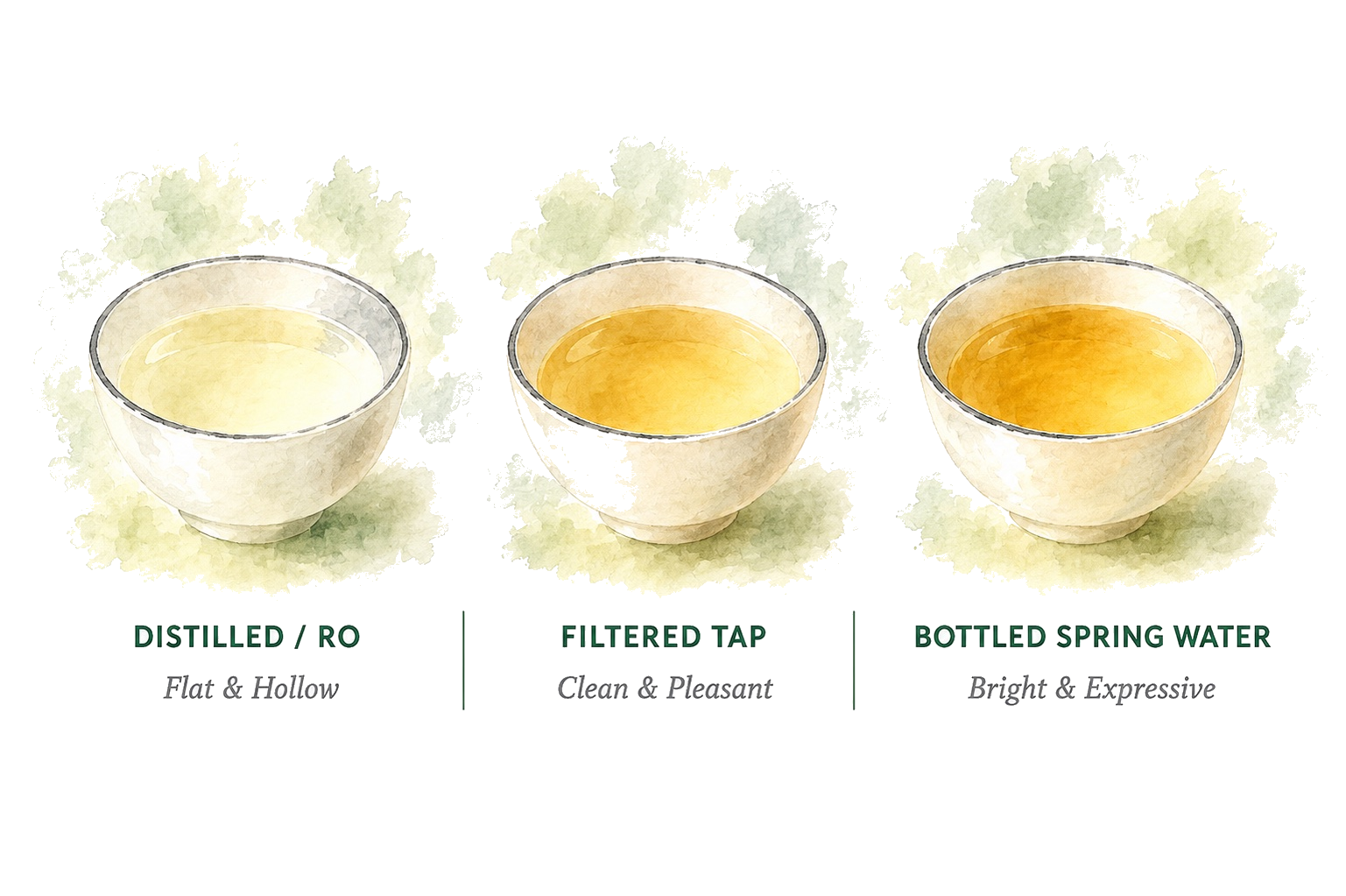
- Flat
- Hollow
- Lifeless cup
- Rougher extraction
- Excess tannin emphasis
- Surface film or scum
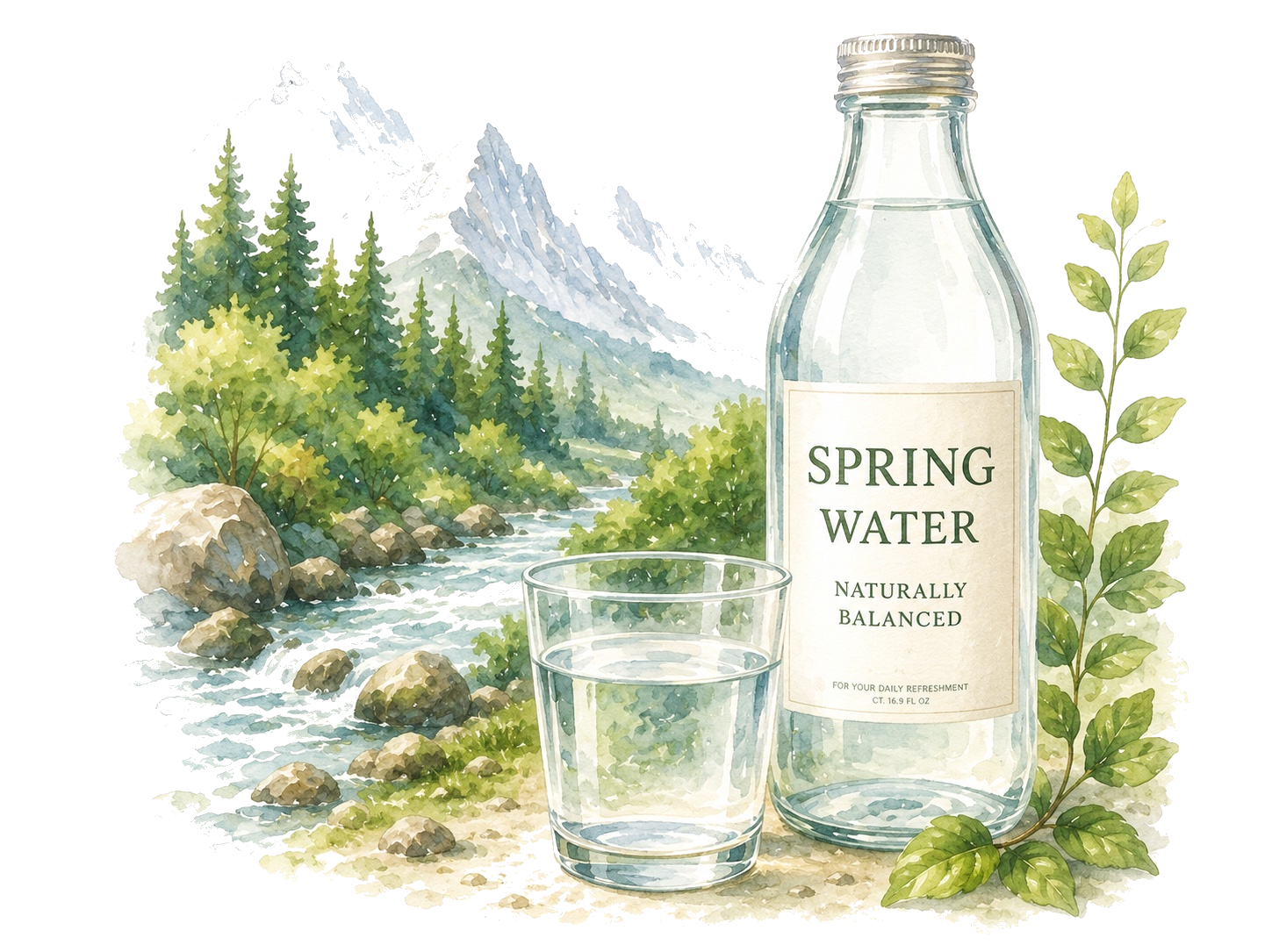
Bottled spring water
- Naturally mineralized
- Clearer flavor
- Smoother body
- Rounder aromatics
- Use bottled spring water when you can.
- Use filtered tap water the rest of the time.
- Avoid distilled or RO water unless remineralized.
If your tap water tastes fine to drink plain, it’ll probably make fine tea once filtered. If it has any smell or edge to it, your tea will, too — and you’ll taste the difference the first time you switch.
When tea disappoints, people blame the leaf first. Often, the real culprit is the water.
Most people picture gongfu as strong tea and Western as weak tea — the same brew at different settings. That’s not what’s happening. The two methods produce chemically different cups from the same leaf because they operate at different points on the extraction curve.
Two regimes, two starting points
Western brewing uses about 1 gram of leaf per 140 millilitres of water and steeps for 2–3 minutes. A single infusion pulls a broad spectrum of compounds into one cup.
Gongfu uses about 1 gram per 80 millilitres — roughly twice the leaf concentration. The water saturates faster, so a 60-second steep extracts a different slice of the flavour spectrum, not a weaker version of the same thing. The Z-Cup on this site is calibrated to that ratio: 3 grams in 8 ounces of water.
Sweetness and aromatics behave differently
At gongfu concentration, sweetness saturates earlier and stays flat — steeping longer won’t make it sweeter. Western sweetness builds more gradually across the full 2–3 minutes.
Aromatics peak earlier in a gongfu steep and fade faster. Western aromatics develop more slowly and linger longer in the cup. Drink gongfu promptly — the aromatic window closes faster than it does in a Western cup.
Bitterness and astringency take time
These heavier compounds diffuse slowly regardless of leaf concentration. A short first gongfu steep ends before they build significantly. A 2–3 minute Western steep gives them more time to accumulate.
Across a full gongfu session of 3–4 infusions from the Z-Cup, total astringency is often lower than a single Western steep from the same leaf — because each individual steep is kept short.
Same leaf. Same variables. Different regimes. Different chemistry. Different experience.
All compounds build together over 2–3 minutes into one complete, balanced cup.
Each infusion reveals a different character. Aromatics lead, sweetness follows, body builds, bitterness stays low throughout.
Neither method is better — they’re different. Western gives you one complete, sociable cup. Gongfu reveals the leaf in layers, cup after cup.
Temperature works exponentially, not linearly. Every 18°F roughly doubles how fast compounds come out of the leaf — a 10-degree change at 195°F does much more than the same 10 degrees at 160°F.
When a cup tastes wrong, temperature is usually the reason — more often than leaf quantity, more often than steep time.
Extraction speed climbs dramatically with heat
Each 18°F step roughly doubles the release rate. A few degrees of error matters more at higher temperatures — you’re operating on a steeper part of the curve.
Temperature doesn’t just make tea stronger or weaker. It decides whether you taste nuance or lose it.
Too cool and the aromatics stay locked inside. Too hot and you scorch what makes it special. The best cup lives between the floor and the ceiling — where you sit within that band is a matter of taste.


Closer to the ceiling gives you more body.
Closer to the floor gives you more nuance.
Find your spot within the range — that’s where preference lives.
Sweet and aromatic compounds release quickly. Bitter compounds release slowly — then accelerate. That’s why time can make or break your cup.
Most of what makes tea pleasant is in the water within the first 60 to 90 seconds. Bitter compounds — mostly caffeine and catechins — are heavier molecules, tucked deeper in the leaf. They release slowly at first, then speed up once the leaf is fully saturated.
A four-minute steep isn’t just “stronger” than a two-minute steep. It’s a different cup, one where bitterness has had time to dominate.
When a tea tastes harsh, the instinct to fix it with less leaf is usually wrong. You need the leaf to build sweetness and body. Shortening the steep is almost always the better move. It keeps the fast-releasing compounds and stops the slow-releasing ones before they take over.
Good steeping isn’t about more leaf. It’s about knowing when to stop.
Aromatics are high.
Sweetness is bright.
Bitterness hasn’t built yet.

Sweetness is steady.
Body is fuller.
A touch of bitterness.
Bitterness dominates.
Aromatics have faded.
The cup tastes different.
Keep it shorter. Capture the good. Avoid the harsh.
Adjust time before you adjust leaf.
A whole leaf isn’t used up after one steep. It’s only getting started.
The first infusion releases the compounds that are easiest to reach — bright aromatics and crisp sweetness. They come out quickly because they live near the surface of the leaf.
What’s left behind is still full of potential. Water penetrates deeper into the leaf with each re-steep, unlocking new layers — rounder sweetness, more body, different aromatics. Each infusion tastes different because you’re meeting different parts of the leaf, not because the tea is getting weaker.
Broken tea runs out quickly because it exposes everything at once. Whole leaves pace the release. A Pure Oolong brewed gongfu style can yield eight distinct cups from a single serving — at the estate, they call it the oolong dance.
Re-steeping isn’t a way to “save” tea. It’s the best way to experience it.


Use whole leaf tea. Expect the first steep to be bright. Add time, not more leaf, and enjoy the evolution.
Gongfu: add 10–45 seconds per infusion. Western: add 30–120 seconds per infusion.
Boiling water isn’t always better. For single-cultivar black tea, it can wash out the very qualities you’re trying to taste.
Most black tea guidance says “boiling water, three to five minutes.” That’s calibrated for full-strength breakfast blends made from different cultivars in different regions.
A single-cultivar black tea from a careful producer is more delicate — honeyed, woody, silky at the finish. Boiling water bullies those qualities out of the cup.
The simulator recommends 176–185°F for three minutes, matching the guidance professional tea sommeliers give for single-cultivar black teas.
Try it both ways. The difference is the kind of thing the three-variable framework is for — a small change in temperature that completely rearranges what you taste.
Boiling gets it out fast. Cooler gets it right.
Delicate aromatics get scorched off. Bitterness and astringency take over.

Aromatics stay intact. Sweetness comes through. The finish feels smooth.

For single-cultivar black tea, start at 176–185°F and steep for 3 minutes.
Save boiling water for tough blends that need it.
The teas behind this guide
The brewing parameters in this framework were calibrated using Zealong whole-leaf teas — certified organic, single-estate, grown in New Zealand’s Waikato region. If you’d like to try the guide on the tea it was built around, Taria imports the full Zealong collection to the US.
See the collection →Found this useful? Pass it along to someone who'd appreciate it.